
Bringing the
Past into the Present


In the latter part of the 1800's "tim-mb-ber-r-r-r" was the cry of a booming economy, and LaCenter was thriving. Most sources say Alan Gibson's logging camp and mill on Jenny Creek, built in 1871, was the first in the area. It wasn't long before other camps and mills followed until there were at least 13 in the area. The West was opening up, rail lines were being built and extended as fast as possible, and the mills around LaCenter were cutting the crossties for that expansion.

In the beginning, teams of oxen struggled over bad roads to get the crossties to the boat landing. Something faster and better was needed. The first flume was built in 1893, and eventually as many as four flumes, some even say seven, brought cordwood destined for Portland, and crossties into town to the steamboat landing.

Around that time the Cape Horn Telegraph connected LaCenter to the rest of the world by wire. It is said the first dispatch out of LaCenter was a hoax perpetrated by unknown persons; the story of a steamboat blowing up near LaCenter. The Highland Sawmill landed a large contract for ties and announced its flume would run day and night. A 2 lb. roll of butter was $.20, eggs were $.10 a dozen, and a cord of wood sold for $1.60. Congress even approved a $10,000 grant to improve travel on the East Fork of Lewis River to the mouth of Columbia. Those were the good ol' days.

By the turn of the century, though, the railroads had all the crossties they needed. One by one the mills near LaCenter closed, and in the 1920's the timber industry was centered around Yacolt. The first decade of the 20th century saw the beginning of the breakup of the steamboat monopoly on transportation with the establishment of a stagecoach run between LaCenter and Ridgefield, and then 1909 incorporation of the town of LaCenter. Not only was rail expansion just about over, but the main line between Seattle and Portland was built to Woodland. LaCenter had been bypassed.

Andrew G. Culbertson, area pioneer and businessman, saw all the prospects of money to be made, and added The Palace Hotel to LaCenter's other businesses in 1881. He built it just north and uphill, from the steamboat landing with an eye to attracting commercial travelers.

Mr. Culbertson knew the value of advertising and the personal touch, and he never missed an opportunity. He met the steamboats as they tied up at the landing, and extolled the comfort and convenience of his hotel. At night he carried a lantern. Not only so travelers would be sure to notice him, but also to light their way to his hotel. He sought the commercial travelers who came to LaCenter to do business with the numerous sawmills in the area, or other businesses thriving in town.

Fire was an ever-present threat to any town before and around the turn of century, LaCenter was no different. It wasn't spared accidental, or man-caused fires. In 1881, the Vancouver Independent newspaper reported "Mrs. Brezee's boarding house burned to the ground" The same newspaper reported that a sawmill and grist mill were destroyed by fire in 1887 and "it was not insured." In 1890, the old wharf and warehouse burned down. "Hard work by a bucket brigade saved the bridge and several other buildings." One of the other buildings was probably The Palace Hotel.

In 1902 a local doctor set fire to his drug store, then shot himself. The fire spread to several nearby stores. Again in 1904, fire spread between buildings and destroyed a tin shop, drug store, butcher shop, harness shop, and damaged The Palace Hotel. It was damaged again in 1907 when the worst fire to hit LaCenter destroyed the post office, Kane Bros. Grocery and several other buildings, along with damaging the bridge. People fought the fire by carrying water from small reservoir behind the Palace.

In spite of the fires, Culbertson and The Palace thrived until at least 1914. In August of that year, Justice of the Peace Joseph Brothers noted that Culbertson filed civil action against one John Shaver for nonpayment of board for the past year, in the amount of $99.55.

The Pacific Highway, a two-lane concrete marvel linking Seattle and Portland, was completed in 1924. The era of the automobile brought a different kind of traveler to LaCenter, families...vacationers and not just businessmen. Those travelers were going to need a place to stay overnight and a gas station/garage. Matt Woodward built a hotel with a restaurant and dance hall on the north side of highway in LaCenter. George Haskins build a gas station and garage next door that also served as headquarters for his Ford dealership. The dance hall in the Woodward Hotel was transformed into a roller rink, and then the hot air balloon repair factory.

Both properties were purchased in the mid 1980's, remodeled into card rooms and restaurants. The properties changed hands again, and were finally sold to Michels Development, LLC in 1998.

The late Dale Michels, founder of Michels Pipeline Construction, Inc., and the Michels Group of Gaming Co's, had gathered a diverse and experienced group of people to develop a series of gaming projects throughout the Midwest and West. In keeping with philosophy of honoring the tradition and flavor of the area, The Palace Casino and Restaurant is the latest example of his vision.

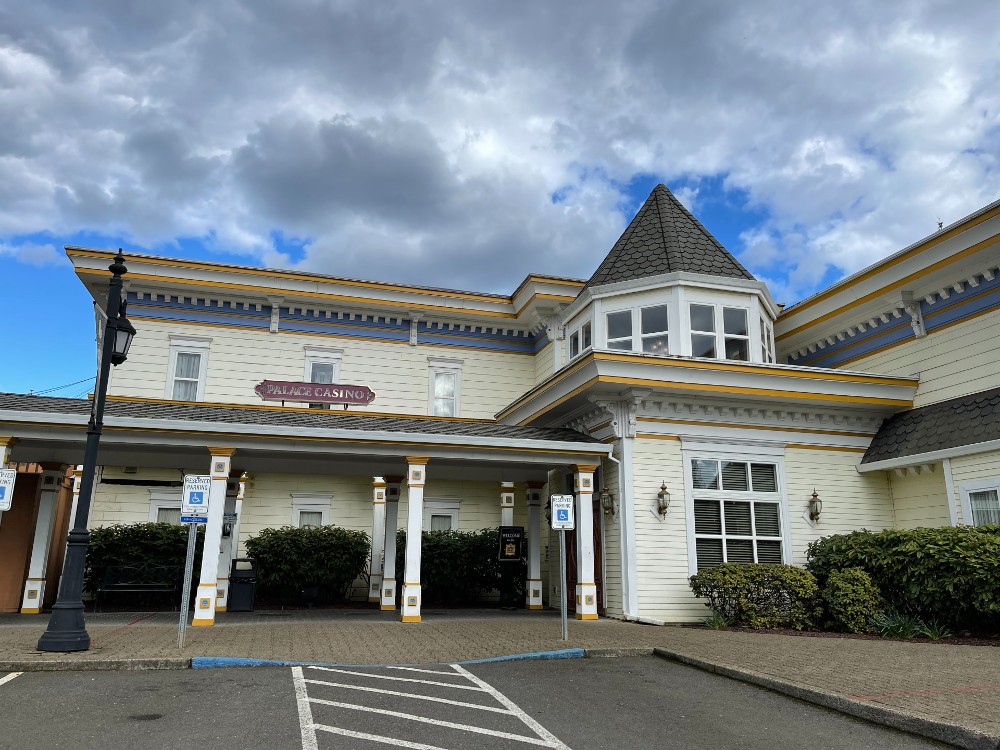
Named after Culbertson's turn-of-the-century Palace Hotel, and built around the old Woodward Hotel building, it seemed only natural to recreate the opulence of the Victorian era. In The Palace Casino Michels Development has created an atmosphere inviting to women as well as men. An atmosphere where the patrons comfort, pleasure and safety are paramount.

Cherry wood paneling accentuate fine copies of paintings framed in the style of the time and displayed throughout the restaurant and casino. Carved ceiling panals lend a note of authenticity to the building.

Antique furniture and a piano near the massive mahogany horseshoe bar create an atmosphere of subdued elegance at the edge of the casino itself, where patrons can relax and watch the action at the Blackjack, Spanish 21, Lucky Ladies, Pai Gow, and Three Card Poker.

Casino patrons as well as residents of the surrounding area will discover in the Palace restaurant or make dining, elegant table settings and impeccable service. A truly distinctive place to enjoy a truly distinctive dining experience.